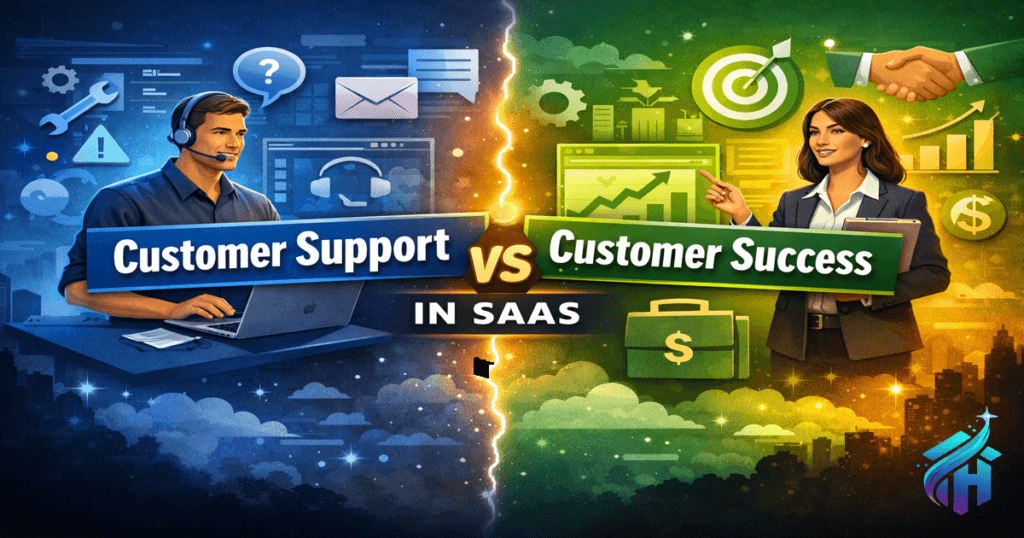
Customer Support vs Customer Success in SaaS: The Ultimate Career, Strategy, and Interview Master Guide
- Professionals choosing between customer support and customer success careers
- Mid-level managers preparing for SaaS interviews
- Leaders building post-sales teams
- Anyone researching the strategic difference between support and success functions
1. Why This Debate Matters in the Modern SaaS Economy
The rise of the subscription economy fundamentally changed how software companies operate. Unlike traditional license-based software models, SaaS companies depend on recurring revenue Monthly Recurring Revenue (MRR) and Annual Recurring Revenue (ARR).
In this recurring model, revenue does not end at the point of sale. It continues only if customers:
- Adopt the product successfully
- Achieve measurable business outcomes
- Renew contracts
- Expand usage
This recurring dependency gave birth to two powerful but distinct post-sales functions:
- Customer Support – Operational reliability and issue resolution
- Customer Success – Strategic growth and retention enablement
Understanding the difference between customer support and customer success in SaaS companies is not just academic it directly affects:
- Revenue retention strategy
- Customer lifetime value optimization
- Career growth potential
- Organizational design
2. Defining Customer Support in a SaaS Environment
Customer Support in SaaS is a reactive, operational function focused on ensuring customers can use the product without technical disruption.
Core Responsibilities
- Ticket management and SLA adherence
- Troubleshooting bugs, configuration errors, integration failures
- Root cause analysis and documentation
- Escalation management with engineering
- Maintaining knowledge base articles
- Incident communication during outages
Support KPIs Explained in Depth
- First Response Time (FRT)
- Average Resolution Time (ART)
- Customer Satisfaction Score (CSAT)
- Ticket Backlog Ratio
- Escalation Percentage
Support is often considered a cost center but high-performing SaaS companies recognize that poor support directly increases churn.
3. Defining Customer Success in a SaaS Business Model
Customer Success is a proactive, strategic function that ensures customers achieve business outcomes using the SaaS product.
Core Responsibilities of Customer Success Managers (CSMs)
- Onboarding strategy and time-to-value optimization
- Product adoption acceleration
- Quarterly Business Reviews (QBRs)
- Customer health scoring
- Renewal ownership
- Upsell and cross-sell identification
Customer Success KPIs Explained
- Net Revenue Retention (NRR)
- Gross Revenue Retention (GRR)
- Expansion Revenue
- Customer Lifetime Value (CLV)
- Product Adoption Rate
Unlike support, customer success directly influences revenue expansion.
4. Deep Strategic Comparison: Support vs Success
| Dimension | Customer Support | Customer Success |
|---|---|---|
| Engagement Type | Reactive | Proactive |
| Revenue Ownership | Indirect | Direct |
| Time Horizon | Short-term issue resolution | Long-term strategic growth |
| Skill Emphasis | Technical depth | Business acumen |
| Stakeholder Level | End users | Decision-makers & executives |
| Primary Metric | CSAT | NRR |
5. Financial Impact: Retention Economics Explained
In SaaS, increasing retention by just 5% can significantly improve profitability due to compounding recurring revenue.
Customer Support protects revenue. Customer Success grows revenue.
A company with strong support but weak success may retain customers but fail to expand them. A company with strong success but weak support may lose trust quickly.
6. Organizational Structure in SaaS Companies
Startup SaaS (Early Stage)
- Support and Success often combined
- Generalists managing both tickets and renewals
Growth Stage SaaS
- Dedicated support teams
- Dedicated CSM teams
- Revenue operations alignment
Enterprise SaaS
- Technical Support Engineers
- Implementation Consultants
- Customer Success Managers
- Account Managers
- Customer Experience Leadership
7. Career Path Comparison and Growth Potential
Customer Support Career Path
- Support Associate
- Senior Support Engineer
- Support Team Lead
- Support Manager
- Director of Support
Customer Success Career Path
- CS Associate
- Customer Success Manager
- Senior CSM
- Director of Customer Success
- VP Customer Experience
Customer Success roles often have higher compensation ceilings due to revenue responsibility.
8. How to Transition from Customer Support to Customer Success
Many professionals search: “How to move from customer support to customer success in SaaS?”
Transition Roadmap
- Learn revenue metrics (NRR, churn, expansion)
- Participate in onboarding calls
- Shadow CSMs during QBRs
- Develop presentation skills
- Understand customer business goals
Support builds product depth. Success requires business depth.
9. Advanced Interview Frameworks
Behavioral Framework: STAR Method
Situation – Task – Action – Result
Example: Customer Support Interview Question
Q: Describe a time you handled a critical SaaS outage.
Situation: Major integration failure impacting 40 clients. Task: Restore service within SLA. Action: Coordinated engineering bridge call, provided hourly updates, created workaround documentation. Result: Restored in 3 hours, CSAT 4.8/5.
Example: Customer Success Interview Question
Q: How do you reduce churn in a B2B SaaS company?
Structured answer should include:
- Health scoring model
- Adoption tracking
- Stakeholder alignment
- Executive reviews
- Renewal negotiation
Strategic Case Study Question
Q: A $50,000 ARR client shows declining usage. What do you do?
Outline:
- Analyze product usage data
- Identify champion risk
- Schedule value review
- Re-align product to goals
- Create action plan before renewal window
10. Skills Deep Dive Comparison
Customer Support Core Skills
- API troubleshooting
- Integration debugging
- SQL basics
- Clear written communication
- Empathy under pressure
Customer Success Core Skills
- Consultative selling
- Executive communication
- Data storytelling
- Negotiation
- Business outcome alignment
11. Salary and Compensation Trends
Customer Support roles often have fixed salaries. Customer Success roles frequently include performance bonuses tied to renewals and expansion revenue.
In mature SaaS markets, CSMs can earn significantly more due to revenue accountability.
12. AI and the Future of Support and Success
AI chatbots and automation will reduce repetitive tickets in support. However, complex troubleshooting will remain human-driven.
Customer Success will evolve toward predictive analytics, AI-driven health scoring, and strategic advisory.
13. Personality Fit: Which Career Should You Choose?
- You enjoy technical troubleshooting
- You prefer structured problem-solving
- You like measurable SLA targets
- You enjoy strategic conversations
- You want revenue ownership
- You like long-term relationship building
14. Frequently Asked Questions (SEO Structured)
Is customer success better than customer support?
Not better different. Success is revenue-driven and strategic. Support is operational and technical.
Can a support engineer become a customer success manager?
Yes. Product depth from support provides strong foundation for success roles.
Who earns more: Customer Success Manager or Support Manager?
Generally, Customer Success Managers have higher earning potential due to revenue impact.
Conclusion: Strategic Alignment Over Comparison
Customer Support and Customer Success are not competitors. They are complementary pillars of a successful SaaS retention strategy.
Support ensures customers can use the product. Success ensures customers want to continue using the product.
For professionals, the decision should be based on:
- Technical vs strategic inclination
- Revenue pressure tolerance
- Long-term career ambition
- Leadership aspirations
Final Thought
In the modern SaaS landscape, the companies that win are those that integrate operational excellence in Customer Support with strategic growth execution in Customer Success.
If you master either and understand both you become indispensable.