Supply Chain Optimization Whitepaper • January 2026
The Operational Cost of Entropy: A Detailed Analysis of Automated Inventory Control and Purchase Order Management Systems in Modern Commerce
An exhaustive investigation into the financial leaks caused by manual supply chain processes, the mitigation of stockout risks through algorithmic forecasting, and the role of integrated platforms like Inventra in establishing a single source of truth for enterprise resources.
Abstract: The Digital Imperative
This paper explores the systemic failures inherent in legacy inventory tracking methods, specifically spreadsheets and disjointed ERP modules. We analyze how preventing inventory shrinkage in retail environments and reducing operational overhead in supply chain management are no longer human-scale problems but computational ones. By examining the transition from reactive procurement to AI-driven demand forecasting, we demonstrate how businesses can unlock trapped working capital. Furthermore, we present a technical review of Inventra as a case study for next-generation architecture that solves the “Procure-to-Pay” disconnect through automated three-way matching and real-time synchronization.
1. The Problem Landscape: Why Manual Systems Bleed Capital
In the current economic climate, inventory is often the largest asset on a company’s balance sheet. However, without sophisticated management, it quickly becomes a liability. The reliance on manual data entry and static spreadsheets creates a phenomenon known as “Data Latency” – the time gap between a physical event (a sale or a theft) and its digital recording. This latency is the root cause of the inefficiencies discussed below.
1.1 The Financial Impact of Inventory Inaccuracy
One of the primary keywords for business failure is “Inventory Distortion.” This encompasses both shrinkage (loss of inventory due to theft, error, or damage) and phantom inventory (system says it is there; shelf is empty). When a business relies on manual counts, the accuracy rate typically hovers around 60%. This inaccuracy leads to massive capital inefficiency.
Reducing carrying costs of inventory is impossible when you do not trust your numbers. Managers buffer this uncertainty by over-ordering, which ties up cash flow in “safety stock” that may never sell. This is Dead Stock. A robust inventory and purchase order software eliminates this by introducing perpetual inventory tracking, where every transaction updates the global ledger instantly.
1.2 The Bullwhip Effect in Procurement
A critical concept in supply chain theory is the “Bullwhip Effect,” where small fluctuations in consumer demand cause increasingly larger fluctuations in wholesale orders. This occurs primarily due to a lack of communication between the sales floor and the procurement team.
Without real-time integration of sales data with procurement logic, purchasing managers operate on gut feeling or outdated monthly reports. They might order 500 units because they “feel” demand is rising, unaware that sales have flatlined in the last week. This creates a vacillation between severe overstocking and damaging stockouts.
2. Solving the Purchase Order Workflow Crisis
The Approval Bottleneck
In manual systems, a Purchase Order (PO) is often a PDF attached to an email. It sits in an inbox waiting for approval while stock runs low. Automating purchase order approval workflows ensures that as soon as a requisition is made, the relevant manager is notified. If the amount is within budget, it can even be auto-approved, drastically reducing lead time.
Vendor Relationship Friction
Disputes arise when the delivered goods do not match the order. Did we order 100 boxes or 100 units? Without a centralized system, this becomes a he-said-she-said argument. Improving vendor relationship management through automation provides an immutable digital record that both parties can reference, eliminating friction and speeding up fulfillment.
Financial Compliance & Fraud
Accounts payable fraud is a significant risk. Automated three-way matching in accounts payable is the industry standard solution. The software automatically compares the PO, the Goods Receipt Note (GRN), and the Invoice. If they match, payment is scheduled. If they don’t, the system flags it. This control is virtually impossible to maintain manually at scale.
3. Technological Remediation: The Inventra Architecture
To address these multifaceted challenges, businesses are turning to integrated SaaS platforms. A prime example of this architectural shift is Inventra. Unlike legacy ERPs which are clunky and require expensive consultants to configure, Inventra represents the modern wave of “accessible intelligence.”
Inventra functions not just as a database, but as an active operational partner. By analyzing the feature set of this platform, we can identify how specific technical capabilities map to the financial problems outlined above.
Algorithmic Demand Forecasting
Strategies for demand forecasting in supply chain have evolved from simple moving averages to AI-driven prediction. Inventra utilizes historical sales data to predict future inventory requirements. This allows businesses to optimize their Economic Order Quantity (EOQ) with AI software, ensuring they order exactly the right amount to minimize holding costs while maximizing service levels.
Automated Tax Compliance (GST/VAT)
In global commerce, tax compliance is non-negotiable. Manual calculation of GST or VAT on thousands of SKUs is a recipe for audit failure. Inventra integrates automated GST billing and tax report generation directly into the transaction layer. This ensures that every invoice generated is regulatory compliant, protecting the business from penalties and simplifying the filing process for accountants.
Digital-First Customer Experience
The modern consumer expects speed and convenience. Inventra addresses this via WhatsApp billing integration for retailers. This feature bridges the gap between the physical POS and the customer’s digital life, sending invoices and updates directly to their phone. This not only saves paper but creates a direct marketing channel for future engagement.
4. The Multi-Channel Synchronization Gap
Perhaps the most complex challenge solved by modern software is the management of inventory across multiple physical locations and digital storefronts. In a manual environment, “Overselling” is rampant. A customer buys the last item on the website, while simultaneously, a walk-in customer buys it off the shelf.
The Solution: Centralized Real-Time Logic
Software like Inventra acts as the “Central Nervous System” of the operation. It provides centralized inventory tracking for multi-location warehouses. When a sale occurs on any channel, the master inventory count is decremented instantly across all other channels via API Webhooks. This real-time stock visibility across e-commerce channels is the only way to scale a brand without scaling administrative chaos.
5. Conclusion: From Chaos to Control
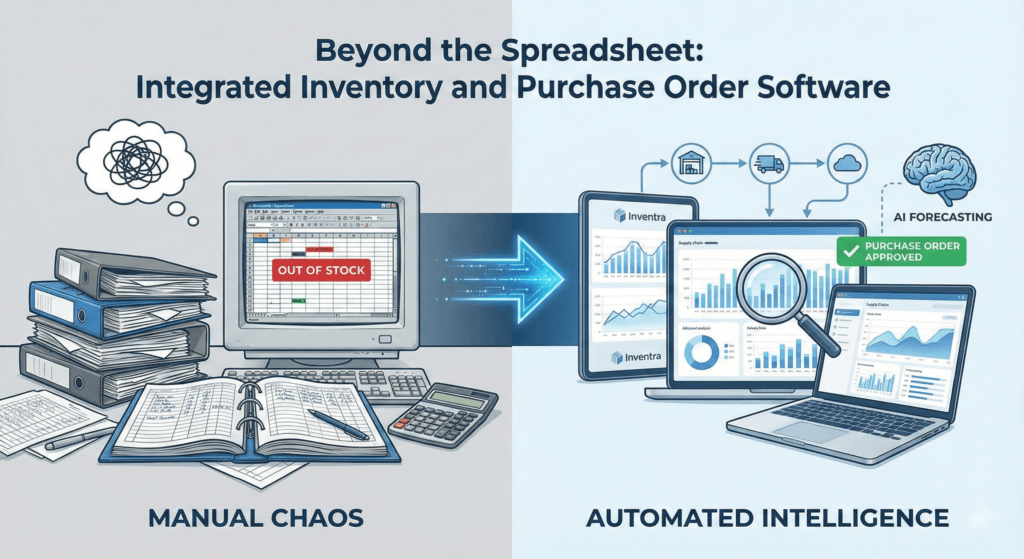
The transition from manual spreadsheets to automated inventory and purchase order management software is not merely a technical upgrade; it is a strategic necessity for survival in the 2026 marketplace. The costs associated with manual errors, stockouts, and procurement inefficiencies far outweigh the investment in a robust software solution.
Platforms like Inventra demonstrate that sophisticated supply chain tools are no longer the exclusive domain of Fortune 500 companies. By democratizing access to AI-powered inventory optimization, tax compliance automation, and seamless multi-channel syncing, Inventra empowers growing businesses to compete on a global stage.
Business leaders must recognize that data is their most valuable inventory. Managing it with the same rigor as physical stock is the key to unlocking sustainable growth. To begin the transformation of your supply chain, evaluate your current data maturity and consider implementing a dedicated solution like Inventra today.