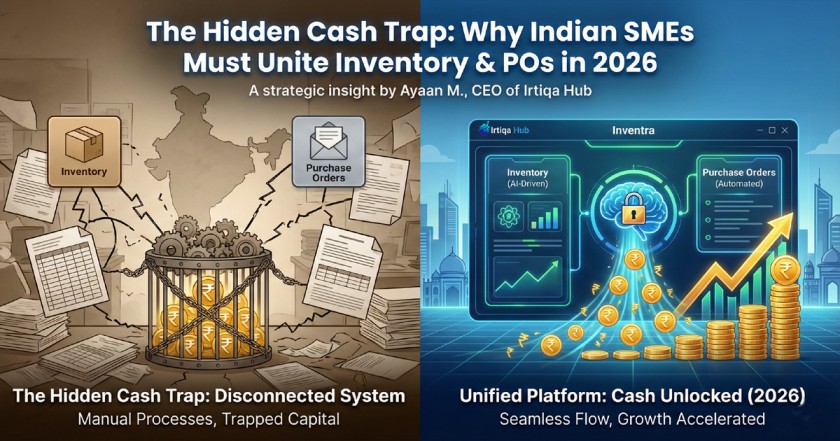
The Hidden Cash Trap: Why Indian SMEs Must Unite Inventory and Purchase Orders in 2026
By Ayaan M., CEO & Founder, Irtiqa Hub
In my years building technology for small and medium enterprises across India and the UAE, I have observed a recurring, painful pattern. It is a silent killer of profitability that many business owners don’t even realize is happening. It is not competition. It is not market volatility. It is the invisible wall that exists between their warehouse shelf and their supplier’s order book.
For too long, Indian SMEs have treated Inventory Management (what I have) and Purchase Order Management (what I need to get) as two separate islands. The warehouse team counts boxes on a clipboard or an isolated Excel sheet. The procurement manager raises Purchase Orders (POs) via emails or WhatsApp messages. The finance team receives invoices that may or may not match what was actually ordered or received.
As we approach 2026, this fragmented approach is no longer just inefficient; it is a massive financial risk. In an era of tight margins and rapid e-commerce fulfillment, the businesses that will thrive are those that tear down this wall and create a unified, intelligent “Stock-to-Sale” workflow.
The High Cost of the “Disconnected Supply Chain”
Let’s look at the ground reality for a typical mid-sized distributor or retailer in India today. They likely use accounting software for billing and GST. They might use spreadsheets for stock tracking. And purchasing? It is often a chaotic mix of phone calls and emails.
This disconnection creates three major financial bleeds:
1. The “Dead Stock” Trap
Without a direct link between sales velocity and purchasing, reordering becomes a guessing game. Purchase managers often over-order “just to be safe,” tying up precious working capital in inventory that sits on shelves gathering dust. This is money that could be used for marketing, expansion, or R&D, frozen in cardboard boxes.
2. The GST Input Tax Credit Leak
In India’s strict GST regime, accuracy is paramount. When a purchase order is raised manually via email, and the goods arrive with a slightly different invoice, reconciliation becomes a nightmare. If the goods received don’t perfectly match the purchase entry in your books, claiming the correct Input Tax Credit (ITC) becomes difficult, leading to direct financial losses or scrutiny from tax authorities.
3. The “Stockout” Opportunity Cost
Conversely, without real-time visibility into inventory levels, purchasing is often reactive instead of proactive. You only realize you need more product when a customer asks for it and the shelf is empty. In today’s instant-gratification economy, that customer won’t wait; they will go to a competitor. A lost sale due to a stockout is the most expensive mistake a business can make.
The 2026 Paradigm: The Unified “Stock-to-Sale” Workflow
The future of SME supply chain management isn’t about having “more” software; it is about having connected software. The shift we are driving at Irtiqa Hub is towards a unified platform where Inventory and Purchasing are completely intertwined.
Here is what that looks like in practice, and why it is transformative:
1. Data-Driven, “Just-in-Time” Purchasing
Imagine a system where your inventory isn’t just a static number, but a dynamic feed. When your stock of a fast-moving item hits a pre-defined reorder point, the system doesn’t just send an alert – it automatically drafts a Purchase Order for the optimal quantity based on your last 30 days of sales velocity. This moves purchasing from a “gut feeling” to a data-science operation, ensuring you carry only the stock you need to meet demand.
2. The “Three-Way Match” Automation
This is the holy grail for finance teams. A unified system allows for an automated three-way match: comparing the Purchase Order (what you asked for), the Goods Received Note (GRN) (what actually arrived in the warehouse), and the Vendor Invoice (what you are being billed for). If these three don’t match perfectly, the system flags it instantly. This eliminates overpayment fraud and ensures airtight GST compliance on purchases.
3. Real-Time Inbound Visibility
Your sales team needs to know what’s coming, not just what’s here. A connected PO system allows your sales staff to see “Available to Promise” stock – inventory that is ordered and on a truck, but not yet physically in the warehouse. This allows them to pre-sell incoming stock with confidence, accelerating cash flow cycles significantly.
The “SME Tech Stack”: How Inventra Replaces Multiple Tools
One of the most common questions I get from business owners is, “Why should I switch if my current system ‘sort of’ works?” The answer lies in the hidden costs of fragmentation. In 2025, the average Indian SME uses 3-4 different disconnected tools to run their business. Let’s break down the typical “Tech Stack” versus the Unified approach.
| Function | Traditional Way (The Old Stack) | The Inventra Way (Unified) |
|---|---|---|
| Invoicing & GST | Standalone Billing Software | All-in-One Dashboard Data flows instantly between all modules. |
| Inventory Tracking | Excel Sheets or Registers | |
| Purchasing | Email, WhatsApp, Phone Calls | |
| Customer CRM | Mobile Contacts or Diaries |
By consolidating these functions, Inventra doesn’t just save subscription costs; it saves context switching time. Your staff doesn’t need to open three different apps to answer a simple customer question like, “Do you have this item, and what is the price?”
Case Study: The “Just-in-Time” Revolution for a Local Distributor
Consider a mid-sized electronics distributor in Hyderabad. Before unifying their inventory and purchase orders, they operated on a “bulk buy” mentality. Once a month, they would order massive stock of cables and chargers to get a vendor discount.
The Problem: This tied up ₹5 Lakhs in capital. Worse, consumer trends shifted quickly, leaving them with unsellable “dead stock” of older charger models.
The Solution: After switching to a unified system, they moved to a weekly purchasing cycle. The system analyzed sales data and flagged exactly which items were moving fast. Instead of one bulk order, they placed four smaller, precise orders.
The Result:
- Cash Flow Released: They freed up ₹3 Lakhs in working capital that was previously stuck on shelves.
- Stockouts Reduced: They stopped running out of high-demand items because the system alerted them before they hit zero.
- Dead Stock Eliminated: They stopped buying items that the data showed were slowing down.
5 Critical Features to Look for in 2026
If you are evaluating software today, do not settle for features that were standard in 2020. The bar has been raised. Here is your checklist for a future-proof system:
- Cloud-Native Architecture: If the software requires you to install a .exe file on a specific computer, walk away. You need to access your business from your phone, from home, or while traveling.
- Granular User Permissions: Your warehouse staff needs to see stock counts, but not your profit margins. Your accountant needs to see invoices, but not edit stock. A good system allows for detailed role-based access.
- Multi-Warehouse Support: Even small businesses often have a shop floor and a separate godown. Your software must treat these as distinct locations to prevent confusion.
- Barcode & Label Generation: The ability to print your own barcodes for unbranded items is a game-changer for speeding up checkout and stock-taking.
- API-First Design: As you grow, you might want to connect your inventory to Shopify, Amazon, or a specialized logistics tool. An API-first platform makes these integrations possible.
🚀 The CEO’s Strategic Framework for 2026
If you are an SME owner looking to modernize your operations, here is the 3-step framework I recommend:
Look at where your data lives. If your inventory count, your vendor list, and your sales invoices are in three different places, you have a silo problem. Map out the manual steps it takes to move data between them.
Don’t get seduced by massive, expensive Enterprise Resource Planning (ERP) systems designed for multinational corporations. Look for agile, cloud-based platforms built specifically for the Indian SME context – tools that offer integrated Inventory, Billing, and PO management without the bloat. Inventra was built specifically for this purpose.
Once your data is unified, turn on the intelligence. Set reorder points for your top 20% of SKUs. Let the system handle the routine purchasing decisions so you can focus on vendor negotiations and strategic growth.
Final Thoughts: Moving From Survivor to Thriver
The Indian SME sector is at a pivotal moment. We are moving away from an era where success was defined by who could work the hardest, to an era defined by who can work the smartest. The government’s push for digitization, combined with the capabilities of AI and cloud computing, has leveled the playing field.
Maintaining separate, manual systems for inventory and purchasing is a legacy mindset. It is a choice to accept inefficiency, errors, and trapped capital. The businesses that will lead in 2026 are those that recognize their supply chain is a single, living organism. By connecting the brain (purchasing decisions) with the body (inventory on hand), you create a business that is agile, resilient, and incredibly profitable.
At Irtiqa Hub, our mission with Inventra is to provide the nervous system for this new kind of business. We believe that powerful, integrated technology shouldn’t be a luxury for large enterprises – it should be the standard for every ambitious SME.
Ready to unify your inventory and purchasing?
Experience the Inventra Difference Today