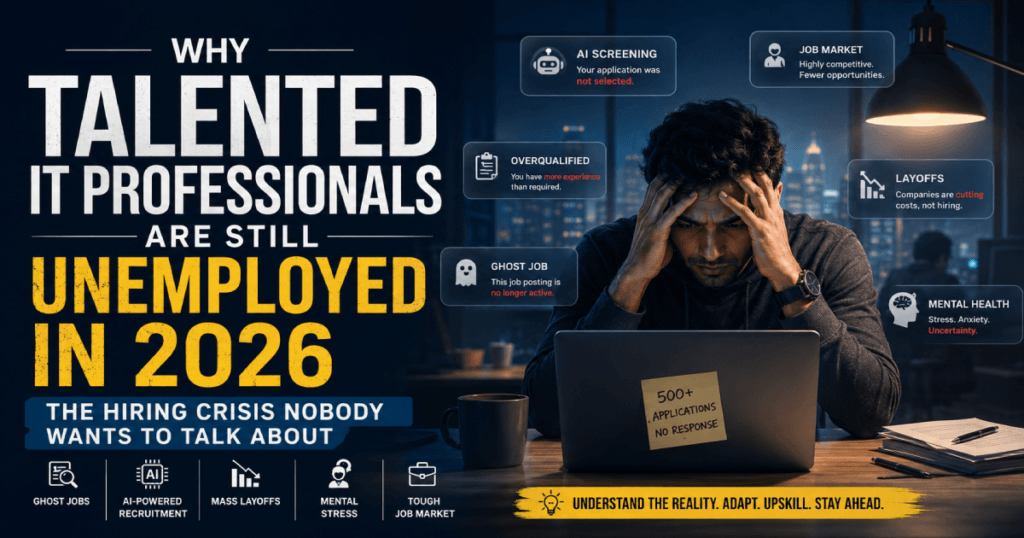
Why Talented IT Professionals Are Still Unemployed in 2026: The Hiring Crisis Nobody Wants to Talk About
Summary: IT Hiring Trends 2026 | AI Recruitment | Career Growth...
Automate Store Invoicing & GST with BillEase Cloud POS
Eliminate thermal paper expenses with instant WhatsApp receipts, print GST-ready invoices in 1.4s, and collect direct UPI payments at 0% fee on mobile and desktop.
!Why talented IT Professionals are still unemployed in 2026
IT Hiring Trends 2026 | AI Recruitment | Career Growth
Why Talented IT Professionals Are Still Unemployed in 2026: The Hiring Crisis Nobody Wants to Talk About
Artificial Intelligence, automated recruitment systems, layoffs, ghost hiring, ATS filtering, and unrealistic job expectations have completely changed the modern IT job market. Here is the uncomfortable reality behind why skilled professionals are struggling to find jobs in 2026.
The technology industry is going through one of the most confusing hiring periods in recent history.
Companies continue posting messages about expansion, innovation, AI transformation, and aggressive recruitment campaigns. LinkedIn feeds are filled with hiring announcements, corporate success stories, and posts celebrating career growth.
At the same time, thousands of highly experienced IT professionals remain unemployed for months.
Software engineers with more than ten years of experience are struggling to secure interview calls. Technical support managers are applying to hundreds of jobs without receiving responses. Cloud professionals, QA engineers, cybersecurity specialists, customer success managers, project managers, and SaaS experts are finding themselves trapped in an unpredictable market.
Something fundamental has changed.
The problem is not a shortage of talent.
The problem is that the entire hiring ecosystem has evolved faster than most professionals could adapt.
“The IT hiring crisis in 2026 is not only about layoffs. It is about transformation, automation, uncertainty, and the growing gap between traditional experience and modern hiring expectations.”
Over the last few years, Artificial Intelligence has reshaped software development, customer support, recruitment, productivity, content creation, analytics, and business operations.
Companies are under pressure to reduce costs, improve efficiency, and scale operations with fewer employees. AI powered tools now automate tasks that once required teams of people.
As a result, the definition of a valuable employee is changing rapidly.
Technical skills alone are no longer enough.
Adaptability, AI literacy, communication, visibility, and strategic positioning are becoming critical career survival skills.
AI Recruitment Systems
Automated resume screening and AI hiring tools are changing how candidates are shortlisted.
Ghost Hiring
Many companies continue posting jobs even when actual hiring activity is limited.
Entry Level Crisis
Fresh graduates are competing against automation and unrealistic hiring expectations.
The Illusion of Mass Hiring in the Technology Industry
One of the biggest frustrations among modern job seekers is the disconnect between public hiring announcements and real recruitment activity.
Every day, companies post messages claiming they are hiring aggressively across engineering, cloud computing, AI operations, cybersecurity, customer support, data analytics, SaaS operations, and digital transformation roles.
Yet candidates continue reporting:
This has led to the rise of what many professionals now call ghost hiring.
Some companies post jobs to create the appearance of growth. Others collect resumes for future hiring pipelines. Some organizations benchmark salary expectations or maintain visibility on hiring platforms even when budgets are frozen.
For job seekers, this creates emotional exhaustion.
Candidates spend hours preparing ATS friendly resumes, researching companies, writing customized cover letters, and completing technical assessments only to never hear back.
Over time, repeated silence creates self doubt.
Professionals begin questioning their abilities even though the issue often lies within the hiring system itself.
Why companies continue posting jobs during hiring slowdowns
How Artificial Intelligence Changed Modern IT Hiring
Artificial Intelligence is no longer just a technology trend.
It is now deeply integrated into recruitment, workforce planning, resume analysis, candidate ranking, interview scheduling, onboarding, and performance management.
Most large organizations now rely heavily on Applicant Tracking Systems and AI recruitment software to manage hiring at scale.
These systems scan resumes automatically and rank candidates based on keyword relevance, formatting, skill alignment, certifications, previous roles, and even writing patterns.
This means many candidates are rejected before a human recruiter ever sees their application.
Modern ATS systems prioritize resumes containing highly specific phrases related to:
Even experienced professionals can be filtered out simply because their resumes are not optimized for AI hiring systems.
This is one of the biggest reasons why highly skilled IT professionals are struggling to get interview calls in 2026.
Resume optimization has become both a technical and strategic requirement.
Top SEO Keywords Trending in IT Recruitment in 2026
AI powered resume optimization, ATS friendly resume builder, IT hiring trends 2026, AI recruitment software, best resume keywords for software engineers, job search strategies for IT professionals, LinkedIn profile optimization for recruiters, AI tools for job seekers, modern recruitment automation, future skills for technology professionals.
Why Experienced Professionals Are Still Unemployed
One of the most painful realities in the modern IT industry is that experience alone no longer guarantees job security.
Many professionals who spent years building successful careers are now struggling to adapt to a market shaped by automation, cost optimization, and AI assisted productivity.
Several factors contribute to this issue.
Professionals who built careers around traditional support systems, legacy technologies, or repetitive workflows are now being forced to reinvent themselves.
This transition is emotionally exhausting.
Many experienced professionals are dealing with:
The emotional impact of unemployment in the technology industry is rarely discussed openly.
Behind every rejected application is a real person trying to support a family, manage financial obligations, and protect their professional identity.
The Entry Level IT Job Crisis in 2026
Fresh graduates are facing one of the toughest job markets in recent history.
Entry level roles that once helped graduates gain practical experience are shrinking rapidly because many routine tasks are now automated through AI powered tools.
Companies increasingly expect freshers to already possess:
This creates a difficult cycle.
Candidates cannot gain experience because companies refuse to hire without experience.
At the same time, AI coding assistants now complete tasks that were once assigned to junior developers.
The result is intense competition for fewer opportunities.
Freshers Need Visibility
LinkedIn activity, GitHub projects, certifications, and portfolios now matter more than ever.
AI Skills Matter
Understanding productivity tools and automation platforms creates a competitive advantage.
Networking Wins
Referrals and strategic networking often outperform mass job applications.
LinkedIn Has Become a Highlight Reel of Success
Social media has dramatically changed how professionals experience career growth and unemployment.
Every day, users see celebratory posts announcing promotions, salary hikes, new jobs, and career achievements.
While these accomplishments deserve recognition, they often hide the emotional reality many professionals are facing behind the scenes.
Thousands of unemployed professionals silently scroll through LinkedIn while battling uncertainty, financial stress, and declining confidence.
This creates comparison driven anxiety.
People begin believing they are failing personally, even though the broader market itself is unstable.
Long term unemployment can affect motivation, relationships, mental health, and self worth.
The technology industry rarely talks openly about the emotional consequences of prolonged job searching.
“Many talented professionals are not failing because they lack skills. They are struggling because the hiring landscape itself has fundamentally changed.”
The New Skills That Matter Most in the AI Era
The future workforce will reward professionals who can combine technical expertise with adaptability and strategic thinking.
The highest value professionals in 2026 are those who understand how to work alongside AI rather than compete against it.
The most in demand skills today include:
Employers increasingly evaluate candidates based on their online presence.
A professional LinkedIn profile, optimized resume, portfolio website, certifications, and industry engagement now play a major role in hiring decisions.
Modern career growth requires visibility.
Professionals who continue learning and positioning themselves strategically will have a stronger advantage in the evolving technology market.
Why Traditional Job Search Methods No Longer Work
Many job seekers continue using outdated strategies in a market that has fundamentally changed.
Sending the same resume to hundreds of job openings is becoming less effective because recruitment systems now prioritize relevance and keyword alignment.
Candidates who succeed in 2026 often focus on:
Visibility has become one of the most valuable career assets.
Recruiters now search for candidates online before scheduling interviews. They evaluate communication style, activity, expertise, and consistency.
Professionals who position themselves effectively often create more opportunities than those relying only on applications.
How CareerLift by Irtiqa Hub Helps Modern Job Seekers
In a recruitment landscape dominated by ATS systems, AI powered hiring platforms, and automated screening software, professionals need smarter career tools to stay competitive.
This is where CareerLift by Irtiqa Hub becomes highly valuable for modern job seekers, fresh graduates, software engineers, customer support professionals, and experienced IT employees.
CareerLift is designed to help professionals improve resume quality, ATS optimization, professional visibility, and interview readiness.
Why CareerLift Matters in 2026
Modern hiring systems are heavily dependent on keyword relevance, ATS compatibility, resume formatting, and skill positioning. CareerLift helps candidates build professional resumes optimized for modern recruitment workflows.
Powerful Features of CareerLift
CareerLift helps professionals present themselves more effectively in a competitive hiring market shaped by AI recruitment technology.
Whether someone is a fresher searching for their first opportunity or an experienced IT professional rebuilding their career after layoffs, modern resume optimization and visibility tools are becoming essential.
Learn more about CareerLift and other solutions from Irtiqa Hub:
Explore Irtiqa Hub SaaS Solutions
BillEase
Smart billing and POS software with mobile invoicing and WhatsApp receipt functionality.
Inventra
Inventory and stock management software for efficient operational control.
TeamHub
Workforce and team management platform built for collaboration and productivity.
Final Thoughts
The IT hiring crisis in 2026 is not simply about unemployment.
It is about transformation.
Artificial Intelligence, automation, cost optimization, changing workforce expectations, and modern recruitment systems have permanently changed how hiring works.
The professionals who succeed in the future will not necessarily be the smartest or the most experienced.
They will be the most adaptable.
Those who continue learning, building visibility, understanding AI powered workflows, and positioning themselves strategically will remain valuable in the evolving digital economy.
Frequently Asked Questions (FAQ)
Q: How does this strategy improve business rankings and search visibility?
A: By implementing targeted keyword optimization, structured schema metadata, and strategic internal linking across ecosystem tools like BillEase, Inventra, and WhatsHub, search engine crawlers index your content with superior topical authority and contextual relevance.Q: Can I integrate these automated tools with my existing workflows?
A: Yes. All Irtiqa Hub products feature robust API webhooks and native integrations that sync seamlessly with your existing point-of-sale, e-commerce, ERP, and CRM platforms.Q: Where can I learn more about optimizing my business operations?
A: Explore our masterclass on The Unified Operations Guide or visit Irtiqa Hub for more enterprise solutions.Recommended Free Business Tools & Calculators
Recent Deep Dive Strategy Guides
- Managing Matrimonial Profiles Without Spreadsheets: Why Excel Fails Growing Marriage Bureaus (and What to Use Instead)
- How Modern Muslim Marriage Bureaus Scale: The Definitive Guide to Matrimonial SaaS, AI Biodatas, and 0% Commission Payments
- Best Free GST Billing Software: What Free Tools Offer & When to Upgrade
- Which Billing Software is Best for Small Businesses? 2026 Selection Guide
- What Are the Types of Invoices in GST? Tax Invoice vs Bill of Supply